
SEO for SaaS Startups: What to Build First
· Cole Stark · 13 min read

SEO for SaaS startups works when you build pages for the searches closest to a signup first, on top of a keyword map, and judge the program by signups instead of traffic. Most startups do it backwards. They publish a blog post a week on broad topics, wait a year, and wonder why nothing converts.
I wrote this SaaS SEO guide for founders and first marketing hires at B2B software companies. I've built organic programs as Head of Growth at Quadratic and Pieces for Developers, and the order below is the one I'd use again: decide which pages should exist, build the ones you can win, and scale only once the system works.
What is SaaS SEO?
SaaS SEO is search engine optimization for software companies: getting your product, use-case and educational pages to rank for the searches your buyers make, so they sign up or book a demo. SEO for SaaS uses the same mechanics as any other SEO. The product, the buyer and the conversion are different.
Software gives you page types other businesses don't have. Every integration, use case, template and competitor is a search someone makes, like "[category] for [team]", "[your tool] [other tool] integration" or "[competitor] alternatives". A restaurant has one menu. A SaaS company has hundreds of legitimate pages it could build from its own product.
B2B SaaS SEO also has to serve a buying committee. The person who finds you on Google often isn't the person who signs the contract, so a page has to work for a user checking features and a manager weighing risk.
Then there's the vocabulary. SEO for tech startups selling to developers, analysts or finance teams means writing for people who search in their own jargon. At Quadratic, the analysts who wanted Python in a spreadsheet and the finance and FP&A teams almost never typed the same query, so each audience got its own themes.
The conversion is the easy part to measure. For a self-serve product, the goal of a page is a signup or a free install, and you can count both by landing page. Few categories let you connect a page to signups this directly.
Is SEO for SaaS startups worth it?
Yes, once you know who buys and why. Organic search produces some of the cheapest customers a startup will get, and they keep arriving after the work is done. It's also slow, and that changes when you should start.
Ahrefs tracked 1 million random pages from its September 2023 crawl and found that only 1.74% reached Google's top 10 within a year. In a separate sample of 1.3 million US keywords, the page ranking first was five years old on average.
So a page you publish today is a bet on next year's pipeline. That's the core tradeoff in SEO for SaaS startups: you have to start before you need it.
I'd hold off on SEO for startups in two situations. Before product-market fit, your positioning will change, and so will the keywords that matter. And if you're creating a category nobody searches for yet, there's little demand to capture, so target the problem your buyers already search for and wait for the category name to catch on.
Paid search is the faster way to learn which queries convert while organic ramps up. I cover how the two channels work together in SEO vs PPC, and where organic fits next to everything else in a startup marketing strategy.
Build the keyword architecture before the content
In SEO for SaaS startups, information architecture comes first: which pages exist, which search each one targets, and how they link together. It's the step most startups skip, and it's why so many SaaS blogs have hundreds of posts and a dozen pages that rank.
The numbers are brutal. Ahrefs found that 96.55% of the roughly 14 billion pages in its index get no traffic from Google. Its main explanations are that nobody searches for the topic, the page doesn't match what searchers want, or the page has no backlinks. Architecture fixes the first two before you write a word.
Map keywords by audience and buying stage
Start from the buyer, not the keyword tool. List your audiences, then the stages each one goes through: understanding the problem, looking for a type of solution, and comparing vendors. Pull the real queries for each stage and group them into themes.
Each theme becomes a cluster. One pillar page covers the broad topic, supporting pages answer the specific questions under it, and they all link to each other. SEO pillars and topic clusters aren't new, but they're still the clearest way to show search engines and AI tools what you know.
Start where you can win
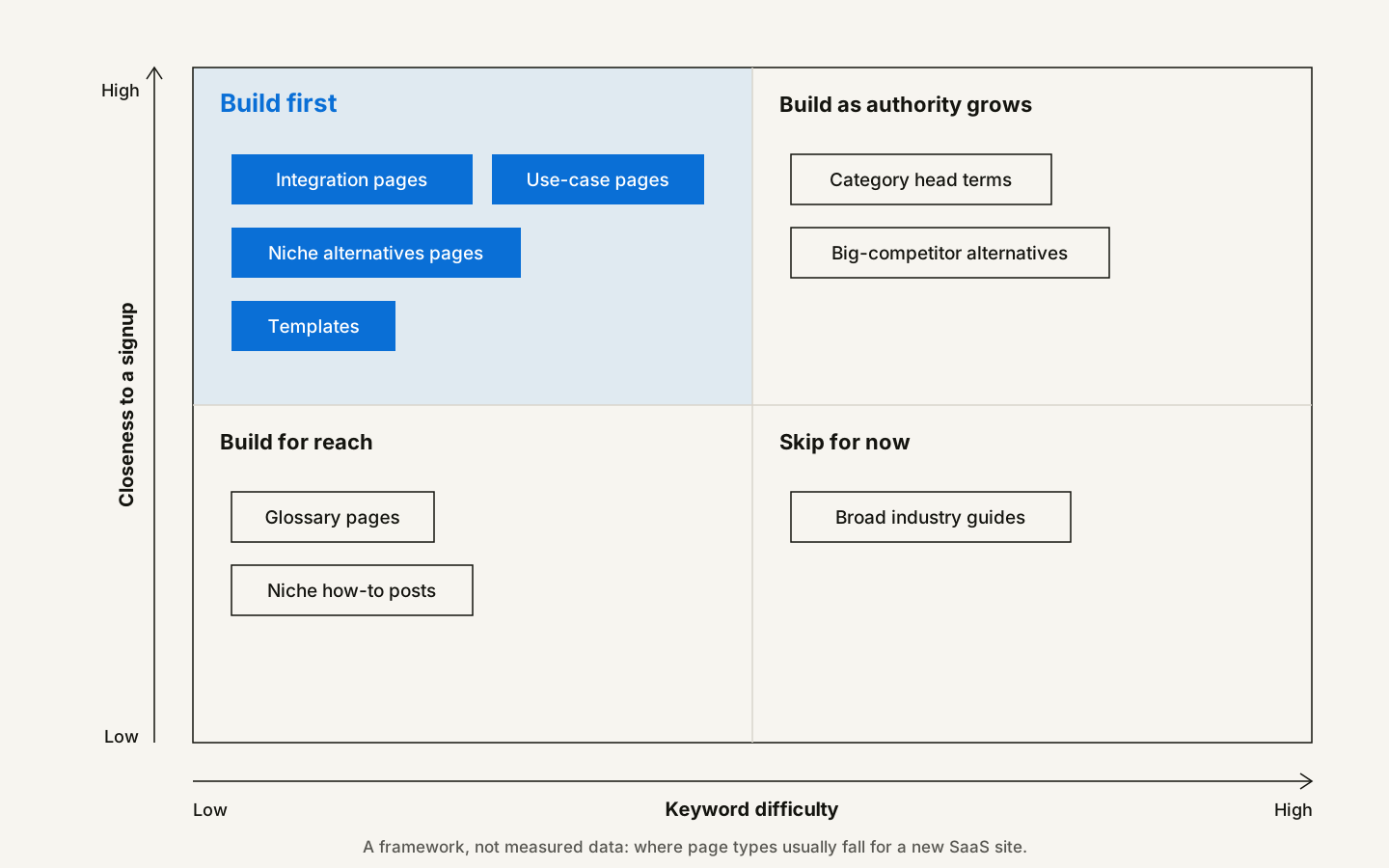
A new domain won't win head terms in its first year. Keyword difficulty, the 0 to 100 score SEO tools give a keyword based on how strong the pages already ranking are, tells you which fights are realistic.
In the same study, Ahrefs advises targeting uncompetitive topics you can rank for with few or no backlinks, and suggests capping keyword difficulty at 20. That's what I do. Start under 20, build pages that rank, and move up as the site earns authority.
Long-tail queries make this possible. A five-word search with 200 monthly searches and low difficulty is worth more to a startup than a two-word term with 5,000 searches it won't rank for in years.
Give every page one job
Assign each page one seed keyword and a few close variants, and never let two pages target the same one. When two pages chase one query, they split the signals and usually neither ranks.
That assignment is keyword mapping. It's the document everything else hangs off: briefs, internal links, and what to build next. When I did it for Pieces as a consultant, the map did more for organic than the next fifty blog posts would have.
The SaaS pages that bring signups
The fastest wins in SEO for SaaS come from the bottom of the funnel, so build from there up. The pages closest to a purchase have the least search volume, convert best in my experience, and are the ones competitors neglect while they chase traffic.
| Page type | Example search | Buying stage | What the page needs |
|---|---|---|---|
| Product and feature pages | "[category] software" | Comparing vendors | Clear positioning, screenshots, a path to pricing, FAQs |
| Use-case and solution pages | "[category] for [team or job]" | Looking for a solution | One job per page and a worked example |
| Integration pages | "[your tool] [other tool] integration" | Comparing or setting up | What connects, setup steps, limits |
| Comparison and alternatives pages | "[competitor] alternatives" | Comparing vendors | A fair comparison and a clear call on who should pick what |
| Templates and examples | "[job] template" | Looking for a solution | Something usable, with a signup to use it |
| Educational and glossary pages | "what is [concept]" | Understanding the problem | A clear definition and a link to the product page it supports |
Comparison and alternatives pages deserve their own note. Buyers search for them right before they choose. In my experience they also shape what AI assistants say about your category, because a fair comparison reads as a source rather than an ad. Write them honestly, including where a competitor is the better fit.
Put FAQs on product and feature pages too, including the questions buyers ask when they're comparing, like "Does it work with X?" and "How is it different from Y?". They catch long-tail searches, and AI answers quote them easily.
Educational content comes last for a reason. It's where AI answers take the most clicks, and a glossary page rarely produces a demo. It still earns its place by building authority on the topic and catching buyers early, as long as each page links to the product page it supports.
Scale content without the slop
Once the architecture exists and the first pages rank, volume becomes the constraint. This is where most startups reach for AI, and where many of them get it wrong.
AI-assisted, human-reviewed
Every AI SEO startup pitch I've seen promises hundreds of posts a month for a flat fee. Google's guidance on helpful, people-first content doesn't ban AI. It says that using automation, including AI generation, to produce content mainly to manipulate rankings breaks its spam policies.
AI in the loop is fine. AI on autopilot is how sites lose their traffic in a core update. At Quadratic, AI drafted for volume and a person reviewed every piece before it shipped. Each post was built around something a model couldn't invent: benchmark-style data, real product screenshots, and an actual opinion.
Review every draft against an SEO copywriting checklist, so each page targets its keyword, answers the query early and reads like a person wrote it.
Programmatic pages with review gates
Programmatic SEO builds pages from a template and a data source: one page per integration, use case or template in your product. Done well, it's a startup's biggest organic asset. Done badly, it's what Google's spam policies call scaled content abuse, many pages generated to manipulate rankings that add little for readers.
A programmatic SEO strategy starts with the data, not the template. If your product data can't make each page genuinely different and useful, don't build the pages. At Quadratic I built a pipeline of roughly 100 steps from a SQL query to a published page with structured data, and a person approved pages before anything went live. The rule was that every page has to be the best result for its query, or it doesn't ship.
Refresh on a schedule
Pages decay. Competitors publish newer versions, screenshots go stale, and in my experience AI tools that search before they answer lean toward recently updated pages. Give your best pages a refresh cycle, quarterly for the ones that drive signups.
Content freshness SEO is mostly unglamorous work: new data, new screenshots, a corrected claim, and a new date only when the page actually changed.
Technical SEO for SaaS sites
Most technical problems on SaaS sites come from how they're built: a marketing site, an app, docs and a blog, often on different systems with different owners. These five cover most of what I find on startup sites.
- Keep the app out of the index. Login pages, dashboards and staging sites should sit behind authentication or carry a noindex rule, so search engines spend their time on pages meant for buyers.
- Make content render without JavaScript. Many SaaS marketing sites run on JavaScript frameworks, and Google's JavaScript SEO basics still recommend server-side rendering or prerendering because it's faster for users and crawlers. Many AI crawlers don't run scripts at all.
- Treat docs as part of the site. Documentation often ranks for integration and how-to searches, so make it crawlable, link to it from product pages, and include it in your sitemap.
- Plan migrations before you redesign. A redesign that changes URLs without permanent redirects can erase years of rankings, and Google's guide to site moves says new URLs can take a few weeks or more to replace the old ones. Website migration SEO comes down to mapping every old URL to a new one before launch.
- Add structured data where it matches the page: Organization, SoftwareApplication or Product, FAQPage and Article.
SaaS technical SEO goes deeper than this list, but a site that gets these five right is ahead of most of its competitors.
SaaS SEO and AI search
More of your buyers' research now ends in an AI answer instead of a click. That changes SEO for SaaS less than you'd think, because rankings still drive what AI tools cite. Seer Interactive found that page-one Google rankings correlated with brand mentions in GPT-4o's answers at about 0.65.
A few things matter more than they used to: pages that answer the question in their first sentences, one consistent description of your company everywhere it appears, FAQs, and AI crawlers allowed through your CDN. My guide to generative engine optimization covers each of them.
Don't run AI search as a separate program with a separate budget. The site that ranks is the site that gets cited.
How to measure SaaS SEO
Measure SaaS SEO in signups. Traffic makes a nice chart, but if organic traffic doubles and signups don't move, you targeted the wrong queries.
These are the four numbers I track, in order of importance:
- Organic signups and activation by landing page, from Google Analytics 4 (GA4) joined with your product data.
- Rankings and clicks for each page's seed keyword, from Google Search Console and a rank tracker.
- Impressions by theme, which move months before signups do.
- Sessions from AI assistants and presence in Google's AI Overviews.
Before you commit a budget, a simple organic search forecasting model sets expectations you can check later: search volume times expected click-through rate times conversion rate, page by page. It will be wrong, but it tells you which pages are worth building and when to change course.
Organic signups should sit in the same report as every other channel, so you can compare cost per customer across them. I wrote more about that in marketing effectiveness, and setting up that reporting is part of my growth analytics work.
In-house, agency or consultant?
Who does your SaaS SEO marketing depends on your stage and budget.
An in-house SEO lead makes sense once organic is a proven channel and there's a full-time job's worth of work. Before that, one hire rarely covers strategy, content, technical work and analytics well.
An agency gives you a team and a process. The risk for a startup is becoming a small account handed to a junior team with a monthly report. If you hire a SaaS SEO agency, ask who will do the work and how they report on signups.
A senior consultant or fractional lead sets the architecture and the system, then your team or contractors execute it. That's how I work, so weigh this paragraph accordingly. Even if you keep writing in-house, keyword research services are an easy piece to hand off.
Whoever you hire, Google's own advice on hiring an SEO is blunt: "No one can guarantee a #1 ranking on Google." Anyone who does is selling something.
Where SEO for SaaS startups pays off
SEO for SaaS startups pays off when it's built as a system: a keyword map that decides what exists, bottom-of-funnel pages first, content at a pace you can review, and reporting in signups. Skip the map and you get a busy blog with no pipeline behind it.
The order matters more than the volume. If you want help building that system, my SEO and GEO services cover the architecture, the pages and the reporting, and the Quadratic case study shows what it looked like at one company.
SaaS SEO FAQs
How long does SEO for SaaS startups take to work?
SEO for SaaS startups takes months to show up in signups. In my experience, pages targeting low-difficulty searches can rank within a few months of publishing, while competitive terms take a year or more. Ahrefs found that only 1.74% of new pages reached Google's top 10 within a year, so start before you need the pipeline.
How much does SaaS SEO cost?
SaaS SEO cost depends on who does the work and how much content you produce. Senior fractional marketing help typically runs about $100 to $170 an hour, agencies usually charge monthly retainers, and content is often the biggest line item. Pay for the keyword architecture first, because it decides whether everything you spend after it works.
What should a startup do first for SEO?
The first thing a startup should do for SEO is decide which pages to build. Map your buyers' searches into themes, assign one keyword to each page, and start with product, use-case and comparison pages that target low-difficulty searches. Then set up Search Console and conversion tracking, so you can see which pages produce signups.
Is SEO for B2B SaaS different from B2C?
SEO for B2B SaaS differs from B2C in who searches and how long they take to decide. B2B buyers search in specialist vocabulary, compare vendors as a committee, and convert through trials or demos over weeks. That means fewer, more specific keywords, more comparison and integration pages, and measurement that follows the account past the first visit.
Do SaaS startups need backlinks?
SaaS startups need fewer backlinks than most SEO advice suggests, especially early on. Ahrefs found that almost all pages getting traffic without backlinks target low-competition topics, so start there. I don't run link-building programs. Links come from pages worth citing, product launches and press.
Should a startup use AI to write SEO content?
A startup can use AI to write SEO content if a person reviews every piece and adds what a model can't: your data, your product screenshots and a real opinion. Google's rules target content made mainly to manipulate rankings, however it's produced. Unedited AI drafts published at volume are the fastest route to a thin-content problem.