SaaS Content Marketing That Drives Signups
· Cole Stark · 12 min read

SaaS content marketing is creating content that helps your buyers solve a problem, ideally with your product, and putting it where they already look: search results, AI answers, newsletters, creators' channels and communities. It works when every piece has a job in the funnel and you measure it in signups. Most of the content marketing SaaS companies publish could have come from any competitor, and it performs like it.
I've run content as Head of Growth at Quadratic and Pieces for Developers. The approach below is the one I'd use at any B2B software startup: a clear buyer, a job for every piece, something only you can say, and distribution that doesn't stop at the blog.
What is SaaS content marketing?
SaaS content marketing is content marketing for software companies: articles, templates, tools, research, video and newsletters that attract the people who buy your product and move them toward a signup. What sets it apart from other B2B content is that the product can be part of the content.
A consulting firm can only describe its work. A software company can show it: a tutorial that solves the reader's problem inside your product, a template they copy into their own account, a free tool that does the first step of the job for them. No publisher competing for the same reader can do that.
B2B SaaS content marketing also has a shorter path to proof. Readers can try the product the same day, so you can judge a page by the signups it produces rather than how many people read it.
The readers are harder to impress, too. Developers, analysts and finance teams are skeptical, and they can tell when a writer hasn't used the thing they're writing about.
The advantages of SaaS content marketing
The advantages of SaaS content marketing come from one fact: content keeps working after you stop paying for it. An ad stops when the budget does. A page that ranks, gets cited in AI answers or gets passed around a community keeps bringing people in for years.
Content marketing for SaaS also makes your other channels work better. Sales sends it to prospects with objections. Paid campaigns get landing pages that answer real questions. Creators have something to point their audience to, and AI assistants have a source to cite.
Producing content isn't the hard part. Getting it to change what readers do is. Among the 1,015 B2B marketers in Content Marketing Institute's 2026 trends survey, 40% named creating content that prompts action, like a conversion, as a challenge. That was the most common answer, ahead of time and budget constraints (39%) and measuring effectiveness (33%).
Build a SaaS content marketing strategy
A SaaS content marketing strategy answers four questions. Who are you writing for, what should each piece make them do, what do you believe that competitors don't, and which topics come first?
Start with one buyer and one problem
Pick the buyer who signs up most easily and the problem that brings them to you. Write for that person until the content works, then expand.
Startups that write for four personas at once usually end up writing for none of them. A narrow content plan feels small, but it's the only way to find out what converts before the budget runs out.
Give every piece a job
Every piece should have one job in the funnel and one number that tells you whether it did that job.
| Buying stage | The job | Formats | The number to watch |
|---|---|---|---|
| Understanding the problem | Get found and earn trust | Explainers, original research, glossary pages | Impressions, new visitors, newsletter signups |
| Looking for a solution | Show your way of solving it | Product-led tutorials, templates, use-case pages | Signups started from the page |
| Comparing vendors | Make the shortlist | Comparison pages, integration pages, customer stories | Signups and demo requests |
| After signup | Get users to value | Onboarding guides, docs, lifecycle emails | Activation rate |
Most startup blogs live entirely in the first row. If yours does, that's why content isn't producing signups.
Have a point of view
AI can now write a competent overview of any topic in seconds, so competent overviews are worth very little. What it can't produce is your data, your screenshots, your customers' stories or your opinion. Build every piece around at least one of them.
State the opinion plainly. "It depends" is accurate and useless. Say what you'd do, and when you'd do something else.
Plan topics from search data and sales calls
Search data tells you what people type. Sales and support calls tell you what they're stuck on, in their own words. Keyword research gives you demand and difficulty, and the questions prospects ask on calls give you angles no competitor has.
Then turn the list into a map that gives each topic one page, so your own pieces don't compete with each other. I cover that process in keyword mapping, and the search side in more depth in SEO for SaaS startups.
Content types that work for B2B SaaS
A blog post is a format, not a strategy. These are the types I'd prioritize for a B2B SaaS startup, roughly in order of how directly they lead to signups.
Product-led tutorials
A product-led tutorial walks through a problem and shows your product doing the hard step. It converts because the reader has watched the product work before they sign up, so the signup is the obvious next step.
Templates and free tools
A template the reader copies into your product, or a calculator that does the first step of their job, puts them inside your product while they're still reading. People share useful things, so these pages also pick up links and mentions without outreach.
Original research
Data only you have, from your product, your customers or a survey you ran, is the one content type competitors can't copy. It's also what journalists and other writers cite. Start small: one chart from your own product data, published with the method behind it, beats a long report nobody finishes.
Comparison and integration pages
These catch buyers who are about to choose. They're as much SEO as content, so plan them with your keyword map and write them fairly, including where a competitor is the better fit.
Customer stories and video
Customer stories close deals more often than they attract traffic, so write them for sales: the problem, the alternatives the customer considered, the result in their numbers, and a quote. Video works in a similar way. Tutorials and walkthroughs on YouTube rank on their own, and creators can carry your product to an audience you don't have yet.
SaaS content marketing examples
These four companies each do one thing well that a startup can copy at a smaller scale.
Ahrefs: product-led content
Ahrefs sells SEO software, and its blog is full of tutorials where its own tools solve the reader's problem. In its explanation of product-led content, Ahrefs says it prioritizes topics that score a 2 or 3 on its own business-potential scale, so the product fits the topic instead of being forced in.
The lesson is to choose topics where your product is genuinely part of the answer.
Zapier: a page for every integration
Zapier's app directory lists more than 9,000 apps, each with its own integrations page. Every page matches a search someone makes when they want two tools to work together, and every page leads to the product.
If your product connects to other tools, each connection is a page worth building.
Notion: templates built by the community
Notion's template gallery has more than 30,000 templates built by its community, and creators can submit their own, get featured and even get paid. Users create the content, and every template is a reason to sign up.
Give your best users a way to publish what they've built with your product.
Muck Rack: original research
Muck Rack makes software for PR teams. Its Generative Pulse report analyzed more than a million links cited by ChatGPT, Claude, Gemini and Perplexity and found that about a quarter came from journalism, a finding its PR customers care about.
Research that answers a question your buyers are already arguing about gets cited and shared far beyond your own channels.
Produce content without the slop
In SaaS content marketing, the process matters more than any single writer. Mine has five steps:
- A content brief: the keyword, the reader, the job, the angle, the sources and the questions the piece must answer.
- An interview with someone who knows the subject, usually an engineer, a salesperson or a customer.
- A draft, with AI helping on structure and first passes where it saves time.
- An edit against an SEO copywriting checklist, plus a fact check of every claim.
- A refresh date, so the piece gets updated instead of abandoned.
AI is already in almost every team's process. In the same CMI survey, 95% of B2B marketers said their organizations use AI-powered applications. Asked about AI-assisted content, 39% said its performance improved, 34% saw no change and 5% said it got worse.
That matches what I've seen. AI makes a good process faster and a bad process louder, so fix the brief and the edit before you add volume.
Distribution: owned, shared, community and earned
Publishing is half the job. Distribution decides whether anyone sees the piece, and I plan it in four places.
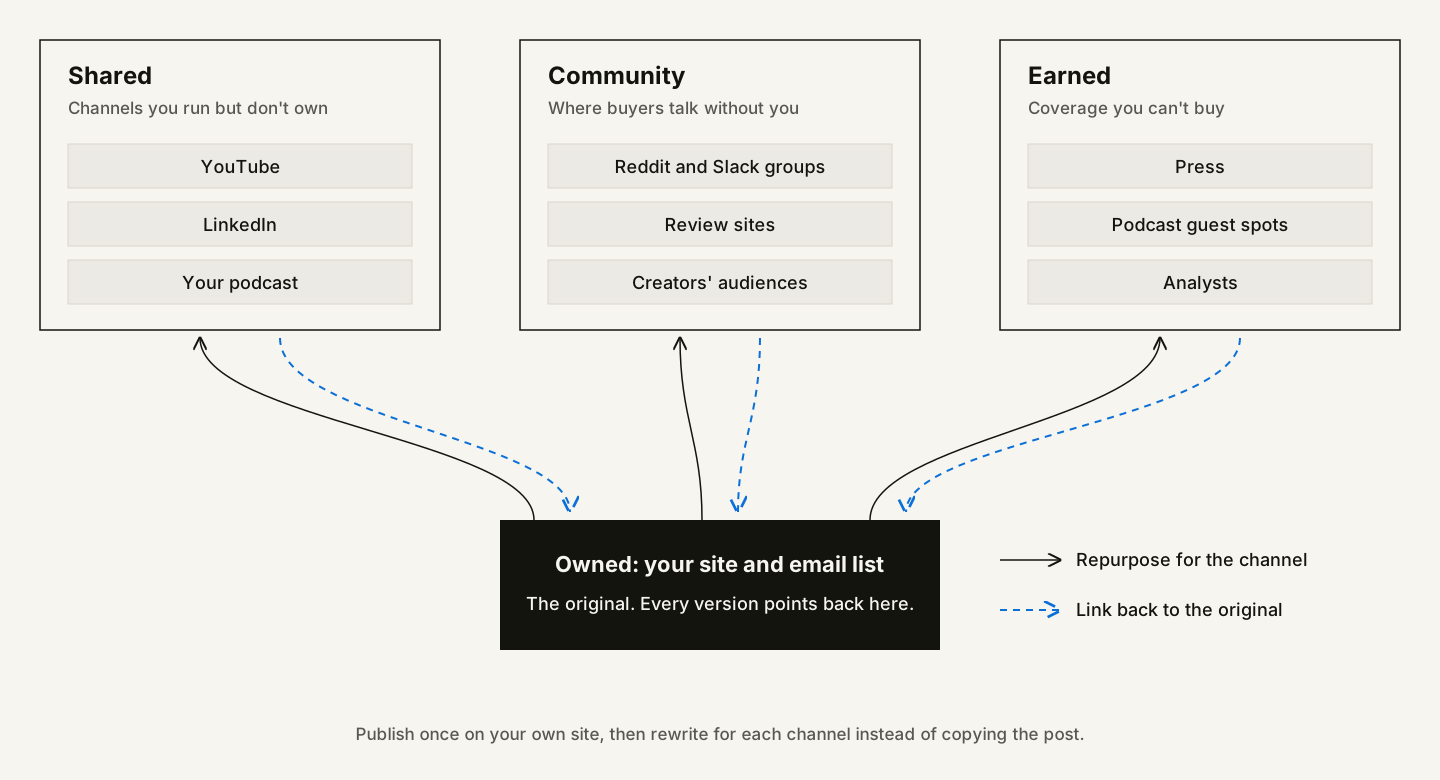
Owned is your site and your email list. Every piece starts here, because it's the version you control and the one that converts.
Shared is the channels you run but don't own: YouTube, LinkedIn, a podcast. Repurpose instead of copying. Turn a post into a short video, a thread or a newsletter section, and link back to the original.
Community is where buyers talk without you: Reddit, Slack and Discord groups, review sites and creators' audiences. Show up as a useful person, not a brand running promotions. Paying creators to show your product in a real workflow is the fastest way into an audience you don't have yet, and it's the core of my creator marketing work.
Earned is press, podcasts and analysts. Original research is the easiest way in, because it gives a journalist something new to report.
What holds the four together is one message across every channel. At Pieces, every launch ran as one campaign across the blog, email, social, paid, community and creators, with the same positioning everywhere. The third launch went better than the first because it ran on a playbook.
Who should do your content?
Your first SaaS content marketing hire should write well and understand the product well enough to use it. A strong SaaS content marketer owns strategy, writing, editing and distribution, and works with sales to find topics.
Freelancers add volume once the process exists. Outsourcing content writing works when the brief carries the expertise: the angle, the sources and the interview notes. Without that, you get generic drafts that take longer to fix than to write.
An agency makes sense when you need a whole team at once. If you hire a SaaS content marketing agency, ask who writes, who edits, whether they'll interview your team, and how they report on signups.
Whoever writes, don't outsource the strategy blind. Someone senior has to own the map, the point of view and the measurement, whether that's a hire, a fractional CMO or a consultant like me.
How to measure content
Measure content by what it makes people do. A third of the marketers in the CMI survey (33%) said measuring content effectiveness is a challenge. These four numbers cover most of it:
- Signups and demo requests by landing page, including the first page a new user saw.
- Assisted conversions: signups where a content page showed up earlier in the journey.
- Self-reported attribution, from a "How did you hear about us?" field on the signup form. It catches the podcasts, communities and creator videos your analytics can't see.
- A leading indicator for each channel: rankings and impressions for search, opens and clicks for email, and branded searches after creator content.
Tag every link you share off-site with UTM parameters, so analytics can tell a newsletter click from a YouTube click. For creator content, capture branded search volume before a video runs, so you have a baseline to compare against. That's how I measured creator partnerships at Quadratic.
Content results belong in the same report as every other channel, so you can compare cost per customer across them. I wrote more about that in marketing effectiveness, and building that reporting is part of my growth analytics work. I'll cover how to measure SaaS content marketing in detail in its own post.
Make SaaS content marketing earn its budget
SaaS content marketing earns its budget when you treat content like a product: a clear buyer, a job for every piece, something only you can say, a distribution plan, and a number that proves it worked. Publishing more is rarely the fix. Publishing pieces with a job is.
If you want help building that engine, my SEO and GEO services cover the content strategy, the production process and the reporting.
SaaS Content Marketing FAQs
How long does SaaS content marketing take to work?
SaaS content marketing takes months to show up in signups, and the timeline depends on the channel. Search content is slowest, because new pages take time to rank. Newsletters, creator videos and community posts can drive signups within weeks, but they stop when you stop. A good program runs both: fast channels for this quarter and search for next year.
Content marketing vs sales for SaaS growth: which comes first?
In content marketing vs sales for SaaS growth, the order depends on deal size. Products with large contracts usually need sales first, with content that supports the sales process. Self-serve products on low-priced plans need content first, because a salesperson doesn't pay for themselves on small deals. Most startups need both, and the best content ideas come from sales calls.
What does a SaaS content marketer do?
A SaaS content marketer plans, writes and distributes content that brings in users. Day to day, that means turning keyword research and sales questions into briefs, interviewing engineers and customers, writing and editing drafts, repurposing pieces for other channels, and reporting on signups. The best ones use the product every day, because readers can tell when a writer hasn't.
What is product-led content?
Product-led content is content that helps the reader solve a problem using your product, as Ahrefs defines it. A tutorial that shows the product doing the hard step is the classic example. It works because the reader sees the product solve their problem before they sign up, which makes the signup the natural next step.
How often should a SaaS startup publish?
A SaaS startup should publish as often as it can produce pieces that meet its own bar, and no more. For most early teams, that's one strong piece a week or less, plus updates to pages that already rank. Consistency matters more than volume. Four useful posts a month will beat twenty that nobody finishes.
Does content marketing still work when AI answers the question?
Content marketing still works when AI answers the question, but the goal shifts from winning the click to being the source the answer cites. AI tools lean on pages that rank, pages with original data and pages that answer clearly. My guide to generative engine optimization covers how to make your content easy for AI search to cite.