
Marketing Attribution Models: What to Trust
· Cole Stark · 8 min read
Marketing attribution models are rules for splitting credit for a conversion across the marketing touches that came before it. No model is true. Each one answers a different question, and each one is blind to whatever your tracking can't see. For most startups, the setup worth trusting is a clean last-click baseline, data-driven attribution where you have the volume, and a "How did you hear about us?" field for everything analytics misses.
At Quadratic I built the growth reporting across product data, GA4, Search Console, the CRM and ad spend, which the Quadratic case study covers. Attribution is the question every one of those systems answers differently. Below is how the models work, what changed in Google's tools, and the setup I'd use at a startup today.
What is marketing attribution?
Marketing attribution is the practice of connecting a result, like a signup or a closed deal, to the marketing that produced it. It's how you decide where the next dollar goes.
The trouble starts because every tool counts differently. Google Ads says it drove 400 conversions, GA4 says 180, the product database says signups were flat, and the CRM shows a different number again. Nobody's lying. Ad platforms count what's good for the ad platform, analytics counts sessions, product data counts users, and they measure at different points.
An attribution model is one piece of the answer: the rule for sharing credit when a buyer touched several channels. The other pieces are tracking you trust and a report that joins the systems together.
The main marketing attribution models
Every marketing attribution model is a different answer to the same question: which touch gets credit?
| Model | How it splits credit | Good for | What it gets wrong |
|---|---|---|---|
| Last click | All of it to the final click before converting | Daily optimization of search and paid campaigns | Ignores everything that created the demand |
| First click | All of it to the first tracked touch | Seeing which channels introduce new buyers | Ignores everything that closed the deal |
| Linear | Equal shares to every touch | A rough view of everything involved | Treats a retargeting impression like a referral |
| Time decay | More credit to touches closer to the conversion | Short sales cycles | Undervalues early discovery |
| Position-based | 40% to the first touch, 40% to the last, 20% shared between the rest | Valuing both discovery and closing | The 40/20/40 split is arbitrary |
| Data-driven | Calculated from your own conversion paths | Accounts with enough conversions to model | Only sees tracked touches, and it's a black box |
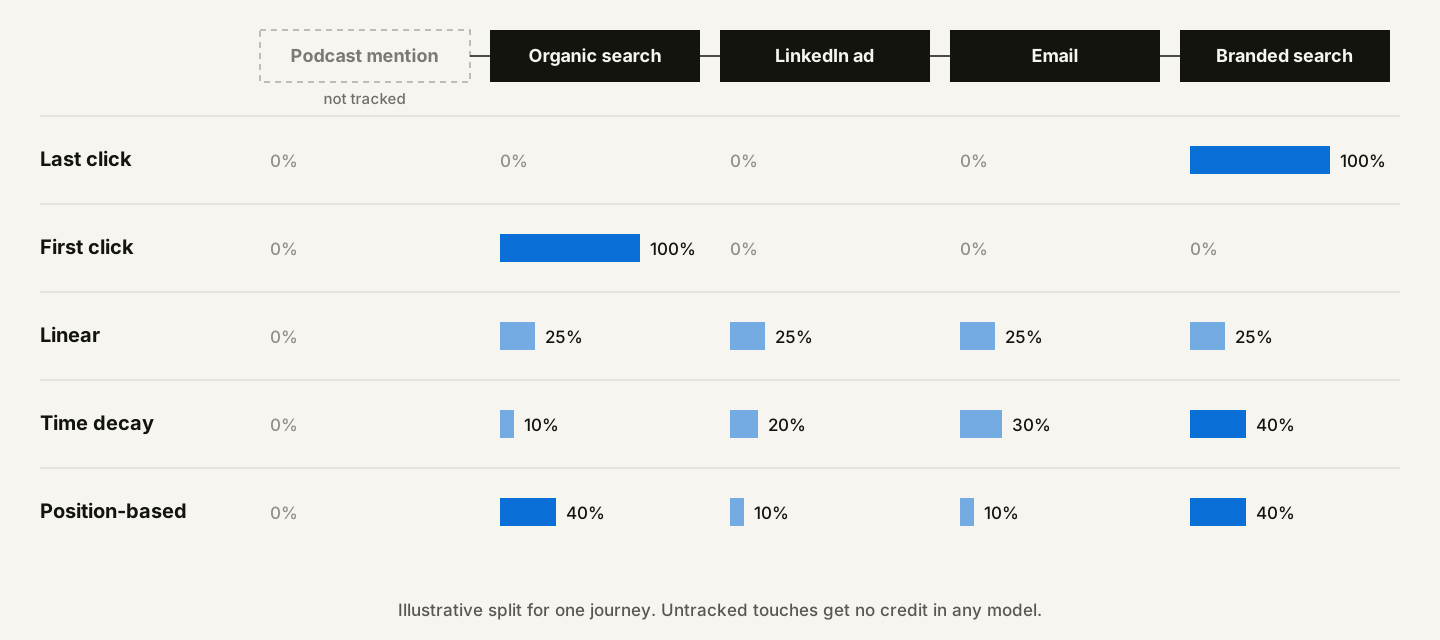
The diagram shows the same journey under five models. Notice what none of them can do: credit a touch that was never tracked, like the podcast where the buyer first heard your name.
What changed in Google Analytics and Google Ads
Most marketing attribution models are gone from Google's tools. In 2023, Google removed first click, linear, time decay and position-based attribution from both Google Ads and GA4. Conversion actions still using them were switched to data-driven attribution that September.
What's left is data-driven attribution, last click and external attribution. Google said fewer than 3% of Google Ads web conversions used the models it removed.
In GA4, data-driven attribution distributes credit based on your own conversion data, and the last-click option ignores direct traffic. Per Google's guide to attribution in GA4, direct visits get no credit under any model unless the whole path was direct.
If you want first-touch or position-based reporting now, you build it yourself, in a warehouse, a BI tool or a spreadsheet, from tracked touches stored against each user.
Multi touch attribution marketing: where it helps and where it breaks
Multi touch attribution marketing tries to give every touch its share instead of crediting one. It's useful when buyers really do take several tracked steps, like an ad, then a webinar, then a demo, and you want to see the path.
It breaks in predictable places:
- Consent and privacy. People who decline cookies, block trackers or switch devices drop out of the path.
- Buying committees. The person who clicked the ad and the person who signed up are often different people on different devices.
- Untracked touches. Podcasts, Slack groups, word of mouth and creator videos watched on a phone rarely leave a click trail.
- Brand search. When a buyer hears about you elsewhere and then searches your name, the credit lands on branded search.
That last one is where most startups misread their data. Last-click attribution flatters search and punishes everything upstream of it. Branded search is usually a symptom of other marketing working, not a channel that created the demand.
B2B marketing attribution
B2B marketing attribution has to follow accounts and deals, not just sessions. A deal might involve five people, three months and a dozen touches, and the marketing touch that mattered may have happened before anyone filled in a form.
Three things make it workable:
- Record the source on the contact and the deal in your CRM, so first-touch and opportunity-source reports exist without a modeling project.
- Send closed deals back to the ad platforms. In B2B PPC, offline conversion imports let bidding learn from revenue instead of form fills.
- Ask. A "How did you hear about us?" field on the signup or demo form, free text or a short list, catches the podcasts, communities and referrals no pixel will.
Self-reported answers are messy, and people misremember. They're still the only view you'll get of the channels that don't click.
Methods beyond models
Marketing attribution models only share credit among touches you tracked. These methods test whether a channel caused anything at all:
- Branded search baselines. Record branded search volume before a creator video, a podcast or a launch, then compare after. At Quadratic, every partnership in our creator marketing program was measured against a branded-search baseline captured before it ran.
- Promo codes and dedicated links. Simple and imperfect, because codes leak to coupon sites, but cheap to run.
- Holdout tests. Turn a channel off in some regions or for a period, then compare. They answer causation questions directly, but you need enough volume for the difference to show.
- Media mix modeling. Statistical models that estimate each channel's contribution from spend and outcomes over time. They need years of data and real budget across several channels, so most startups aren't there yet.
The first three are within reach of almost any startup. Media mix modeling is worth revisiting once spend and history justify it.
How to choose a marketing attribution model
Choose the setup before the model. Here's the one I'd use at a startup:
- Make the tracking true. Conversions that fire once, carry a value, and connect to the CRM. No model fixes bad inputs.
- Use last click as the daily baseline for search and paid campaigns, with brand reported separately from non-brand.
- Turn on data-driven attribution in GA4 and Google Ads once you have the conversion volume for it.
- Add the "How did you hear about us?" field, and read the answers weekly.
- Measure upstream channels like creators, podcasts and PR with branded search baselines and dedicated links.
- Write an attribution policy, so the numbers mean the same thing every week and nobody changes the model to win an argument.
- Join product data, GA4, the CRM and ad spend in one weekly report, from visitors to signups to paying customers by channel, with cost.
I wrote about the reporting side in marketing effectiveness, including how to compare channels once the numbers agree.
Pick marketing attribution models you can defend
The best marketing attribution models are the ones you can explain to a board and that stay stable week to week. Use last click for daily decisions, data-driven where you have the volume, and self-reported data plus branded search baselines for what tracking can't see. Then stop arguing about the model and start moving budget.
If your dashboards disagree and nobody knows which one to believe, my growth analytics work starts by making the tracking true, then builds the one weekly view everyone uses.
Marketing Attribution FAQs
What is the best marketing attribution model?
The best marketing attribution model depends on the decision you're making. Last click is best for daily search and paid optimization, first click for seeing which channels introduce new buyers, and data-driven for accounts with enough conversions. Most startups should combine last click with a "How did you hear about us?" field rather than chase one perfect model.
What is the difference between single-touch and multi-touch attribution?
Single-touch attribution gives all the credit to one touch, either the first or the last. Multi-touch attribution splits credit across every tracked touch, using a fixed rule like linear or position-based, or a data-driven model. Multi-touch shows more of the journey, but it still can't see touches your tracking misses.
Does GA4 still have first-click attribution?
GA4 no longer offers first-click attribution as a model. Google removed first click, linear, time decay and position-based attribution from GA4 and Google Ads in 2023, leaving data-driven and last click. You can still build a first-touch report yourself by storing each user's first source and joining it to conversions.
How do you attribute word of mouth and podcasts?
You attribute word of mouth and podcasts by asking and by watching brand search. A "How did you hear about us?" field on your signup or demo form captures the sources no pixel tracks. Comparing branded search volume before and after a podcast or creator video shows whether it moved demand.
What attribution model works best for B2B?
For B2B, the attribution model matters less than tracking accounts and deals in your CRM. Record first touch and opportunity source on every deal, import closed deals into your ad platforms, and add self-reported attribution. Position-based or data-driven models help on top of that, but only once the CRM data underneath is reliable.
Is marketing mix modeling worth it for startups?
Marketing mix modeling is rarely worth it for early startups, because it needs years of data and meaningful spend across several channels to produce stable estimates. Until then, branded search baselines, holdout tests, dedicated links and self-reported attribution answer most of the same questions for far less effort and cost.