PPC for B2B: Pay for Customers, Not Clicks
· Cole Stark · 9 min read
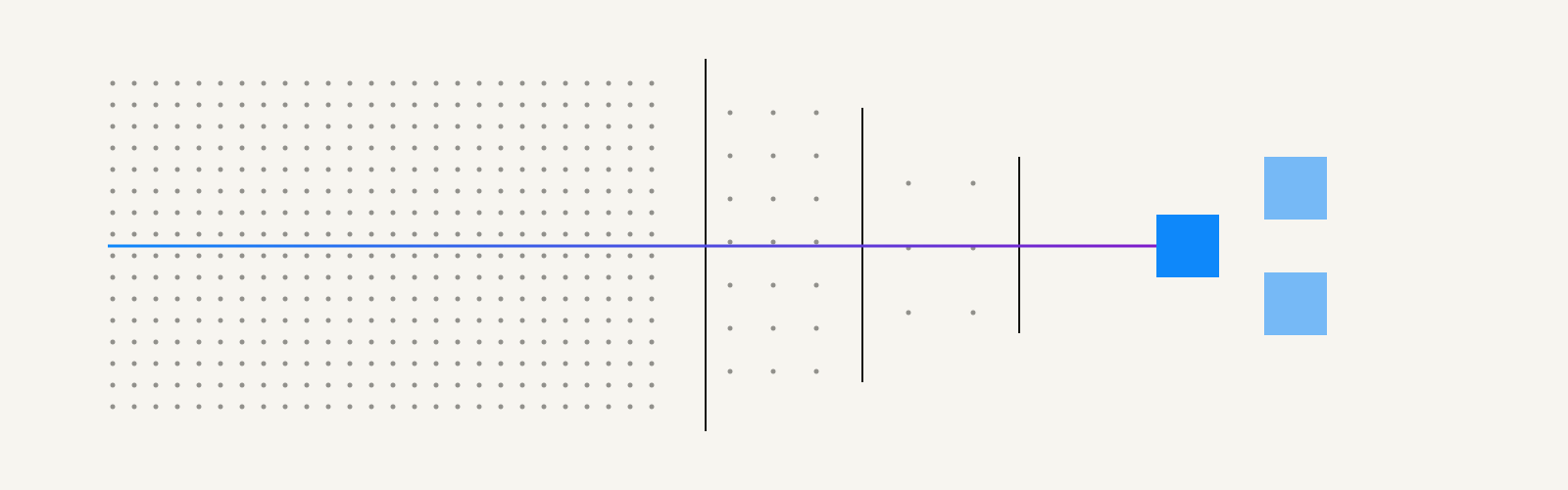
PPC for B2B works when the account is built around paying customers instead of clicks: tracking that reaches your CRM, campaigns split by search intent, landing pages that answer the query, and budget that follows customer acquisition cost. Most of the PPC B2B companies run optimizes toward form fills, and the report looks great while sales wonders where the leads went.
I've run Google Ads for more than ten companies, from agency accounts to my own budget as Head of Growth. The fixes below are the ones I make in almost every account, in the order I make them.
What is B2B PPC?
B2B PPC is pay-per-click advertising aimed at business buyers: search ads on Google and Microsoft Advertising, plus paid social and video on LinkedIn, YouTube and Meta. You pay when someone clicks, so the whole game is paying for the right clicks.
B2B paid search is different from consumer search in four ways that change how you run it:
- Search volume is small. A niche software category might have a few hundred searches a month, so every wasted click hurts.
- Clicks are expensive, because every competitor is bidding on the same handful of terms.
- The buyer is a committee. The person who clicks your ad is often researching for someone else.
- The sale happens later and somewhere else: a demo, a trial, a contract signed weeks after the click.
That last one is why most B2B accounts go wrong. If Google can't see the sale, it optimizes for whatever it can see.
Is PPC for B2B worth it?
PPC for B2B is worth it when three things are true. People already search for your category or the problem you solve, you can track a click through to revenue, and your customer lifetime value can absorb the cost per click.
If nobody searches for your category yet, search ads have nothing to capture. Paid social, creators and content will do more. If you can't track past the form fill, fix that first, because every bidding decision you make before then is a guess.
Paid search is also the fastest way to learn which queries convert while organic catches up. I covered how the two channels feed each other in SEO and PPC working together.
Start with tracking
Tracking is the foundation of any B2B paid search strategy, and it's the part most accounts get wrong. Smart Bidding, Google's automated bidding, does exactly what it's told. If a conversion fires on a page view, counts twice or stops at the form fill, the algorithm optimizes toward noise.
Fix it in this order:
- Pick conversion actions that matter, and give each a value: a signup is worth this, a booked demo is worth that, a paying customer is worth more.
- Send the outcomes back from your CRM. Google's offline conversion imports exist for exactly this case, where an ad starts a path that ends in a sale over the phone or in a meeting.
- Add enhanced conversions for leads, which matches hashed first-party data like email addresses to tie those CRM outcomes back to ad clicks.
- Make only the conversions that predict revenue primary, so bidding learns from closed deals and qualified pipeline rather than form fills.
At Quadratic, rebuilding conversion tracking around value was part of the paid overhaul, along with separating brand from non-brand and moving budget weekly by cost per paying customer. Tracking is the step I'd do first anywhere. Setting up that reporting is the core of my growth analytics work.
Build a B2B PPC strategy around intent
A B2B PPC strategy starts with structure. Split campaigns by what the searcher wants, so each one has its own goal, budget and benchmark.
| Campaign | Example search | What the searcher wants | How to run it |
|---|---|---|---|
| Brand | "[your company] pricing" | You, specifically | Its own campaign and budget. Never report it with non-brand |
| Competitor | "[competitor] alternative" | A different vendor | Fair comparison landing pages, expect higher costs |
| Category | "[category] software" | A tool like yours | Exact and phrase match, landing pages per use case |
| Problem | "how to [job your product does]" | A way to solve something | Lower intent, worth testing with a guide or template |
| Retargeting | (people who visited) | To come back when ready | Display, YouTube and paid social, capped frequency |
Brand campaigns deserve the most suspicion. Branded search gets lifted by every other channel you run, so lumping it in with non-brand makes paid search look better than it is. Budgets get misallocated for years that way.
Competitor campaigns are their own discipline, with real costs and some legal lines. I covered how to run them in competitor conquesting.
Match types and negatives
Google defines match types by how loosely a search can relate to your keyword. Broad match can show your ad on related searches, phrase match on searches that include your keyword's meaning, and exact match on searches with the same meaning or intent.
Use exact and phrase match where control matters, which is most of a B2B account. Broad match only earns its place once you have enough conversion data for bidding to learn from, and even then it needs a long negative keyword list.
Every B2B account should exclude job seekers, students and people looking for free versions. Terms like "jobs", "salary", "course", "certification", "free" and "open source" waste more B2B budget than anything else I see in search term reports.
Landing pages built for the query
Don't send paid traffic to your homepage. Send it to a page that answers the search, with a call to action that matches the intent behind it.
Someone searching "[category] software for [team]" wants to see that you serve their team. Someone searching "[competitor] alternative" wants a fair comparison. Someone searching a problem wants a way to solve it before they're asked for a demo.
Match the ask to the stage. A demo request suits a high-intent query and a high-priced product. A free trial or a template suits everything earlier. Keep forms short, and only ask for what sales actually uses.
Write ad copy that qualifies the click
Ad copy is the cheapest filter in PPC for B2B. A click from someone who can't buy costs the same as a click from someone who can, so write ads the wrong people will skip.
Say who the product is for, like "for finance teams" or "for engineering teams of 20+". If a small budget rules people out, say where pricing starts. Put your most specific proof in the headline: the integration they need, the compliance standard they ask about, or the tool you replace.
Then make the landing page keep the ad's promise. If the ad offers a comparison, the page should open with one. A mismatch costs you the click and teaches Smart Bidding the wrong lesson.
Where to run B2B PPC advertising
B2B PPC advertising isn't only Google. Each platform does a different job:
- Google Search is the core. It's where people with a problem and a budget go looking.
- Microsoft Advertising is quietly useful for B2B, because it lets you adjust bids based on LinkedIn profile data like company, industry and job function. It's a bid adjustment, not a filter, so it raises bids for the right people without hiding your ads from everyone else.
- LinkedIn Ads target by job title and company with real precision, at a price. I use them for retargeting and named accounts more than cold acquisition.
- YouTube is for discovery and for retargeting people who searched but weren't ready.
- Retargeting across Meta, LinkedIn and X catches the visitors who came, read and left.
Search captures demand. The others create it or bring people back, and they need different goals. I run those through paid social.
Budget and bidding for B2B PPC campaigns
Give each B2B PPC campaign enough budget to produce conversions every week. A campaign that gets two conversions a month can't teach Smart Bidding anything, and you can't judge it either.
Start narrow. Fund brand and your best category terms first, prove them, then expand into competitor and problem campaigns. Five well-funded campaigns beat twenty starved ones.
Once offline conversions flow back with values, move to value-based bidding so Google bids for customers, not leads. Then review weekly against one number: cost per paying customer by campaign. Reallocate toward the campaigns that produce customers, even if their cost per click is higher.
B2B PPC tips
These are the B2B PPC tips I'd give any startup running its own account:
- Read the search terms report every week for the first three months.
- Write ad copy that filters. Mention the price tier or "for teams" if that keeps the wrong people from clicking.
- Bid on acronyms and jargon your buyers use, not just the full product category.
- Exclude existing customers from acquisition campaigns, so you don't pay to bring back people who already pay you.
- Check ad schedules. Many B2B searches happen during work hours, and your data will show whether evenings are worth paying for.
- Keep brand, competitor and non-brand budgets separate, so a strong brand week can't hide a weak non-brand one.
B2B SaaS PPC: how to measure it
B2B SaaS PPC should be measured in paying customers, not clicks or leads. Report cost per paying customer and payback period by campaign, with brand separated from non-brand.
Expect the numbers to lag. If your sales cycle runs six weeks, a campaign's real results show up six weeks after you change it, so judge changes on the cycle, not the week.
Paid results belong in the same report as every other channel, so budgets can move between them. I wrote about that comparison in marketing effectiveness. For how credit gets shared across channels before a deal closes, see my guide to marketing attribution models.
Make PPC for B2B accountable to revenue
PPC for B2B pays off when the account knows what a customer is worth and bids for customers. Fix the tracking, split campaigns by intent, build landing pages for the query and move budget weekly toward the campaigns that produce paying customers. Everything else is tuning.
If your account is optimizing for something other than paying customers, my paid search services start with an audit that shows what it's costing you.
B2B PPC FAQs
Does PPC work for B2B?
PPC works for B2B when people already search for your category and you can track clicks through to revenue. B2B accounts fail when they optimize for form fills, mix brand with non-brand, or send traffic to the homepage. Fix tracking first, then structure campaigns by intent, and judge results by cost per paying customer rather than cost per lead.
Is LinkedIn or Google better for B2B PPC?
Google is usually better for B2B PPC when buyers already search for what you sell, because it captures existing demand. LinkedIn is better for reaching specific job titles and companies who aren't searching yet, at a much higher cost per click. Most startups should start with Google, then use LinkedIn for retargeting and named accounts.
How much should a B2B startup spend on PPC?
A B2B startup should spend enough on PPC for each campaign to produce conversions every week, which depends on your cost per click and conversion rate. Start with brand and your best category terms, prove them, then expand. A small budget across a few campaigns teaches you more than the same budget spread across twenty.
How long does B2B PPC take to work?
B2B PPC shows clicks immediately, but real results take at least one sales cycle. Smart Bidding needs a learning period after changes, and offline conversions from your CRM arrive weeks after the click. Plan on a quarter before you judge a new account, and judge changes against the length of your sales cycle.
Should B2B companies use Performance Max?
B2B companies should use Performance Max carefully, if at all, before their tracking is solid. It spreads budget across Google's channels and can drift into branded searches you'd get anyway. If you test it, feed it value-based conversions from your CRM and use brand exclusions to keep it off your brand terms.
Should you hire a B2B PPC agency?
You should hire a B2B PPC agency when you need hands on the account every day and don't have someone senior to set strategy. Ask how they track conversions past the form fill, whether they separate brand reporting, and how often they reallocate budget. If an agency reports clicks and leads but never customers, keep looking.